

When I opened the recipe impregnated with curry stains for the first time in _Venba_ and tried to identify the stained Tamil text, it was snowing in Toronto outside the window. In the game, my finger slides on the iPad to try to restore a “Pongal” step; in reality, my stomach reminds me of my grandmother stirring pottery in the morning light. This cooking game uses the most ordinary kitchen scene to cook 40 years of nostalgia.
The game opened in Canada in 1988. _Venba_, whom I play, is anxious about the life of new immigrants, and the family recipe brought from South India has become her final connection with her hometown. But when I really started to operate, I found that many recipe steps were blurred — this was not a step-by-step cooking simulation, but an archaeology of memory restoration.
The most touching thing is the game’s restoration of “imperfection”. When I made Idli for the first time, I forgot to apply oil on the mold, which caused the rice cake to stick to the container. Just when I was upset, the husband in the game laughed and scraped off the residue: “This is more crisp, just like the feeling of stealing pot when we were young.” This tolerance for failure makes every kitchen accident a metaphor for cultural adaptation.
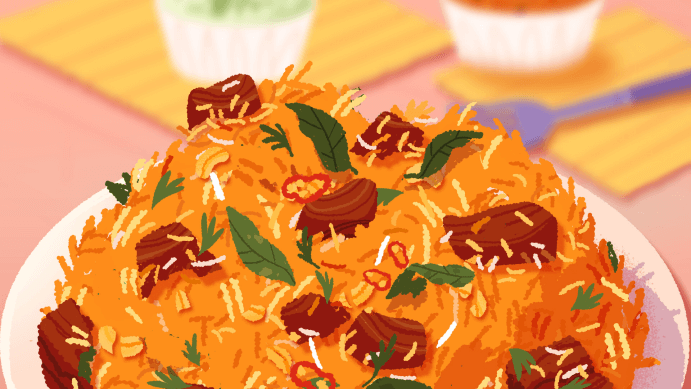
The recipe itself is like a family code book. When _Venba’_s son Kavin grew up and refused to learn the traditional diet, those restored recipes suddenly became a bridge of intergenerational dialogue. Once I need to restore a “Biryani” through repeated experiments — add spices or stir-fry rice first? Would you like to add yogurt? Each choice corresponds to a different philosophy of life. When the final product was fragrant, I seemed to hear three eras talking in the same kitchen.
The game’s attention to detail is amazing. When making “Puttu”, it is necessary to accurately grasp the layering of rice noodles and shredded coconut, and control the fermentation time of the dough when making “Dosa”. Once when I was preparing “Rasam”, the character coughed because of too much pepper. This unexpected design made me laugh out loud in front of the screen — just like my mother was choked by chili in my memory.
As time goes on, the layout of the kitchen is also changing quietly. From the original simple immigrant apartment to the later modern kitchen, the pottery jars on the stove were gradually replaced by non-stick pans, but the worn-out recipe was always placed in the most convenient position. When the game came to 2016, the old _Venba_ taught his granddaughter to make “Appam” in rehabilitation, the trembling hands and patient guidance reminded me of my grandmother.
On the weekend after customs clearance, I walked into the local Indian grocery store. Looking at the strange spices on the shelf, I suddenly understood _Venba’_s mood when he was looking for curry leaves in a Canadian supermarket for the first time. I bought all the materials and tried to make “Masala Chai” according to the memory in the game. When the aroma permeated the whole apartment, it seemed to travel through time and space for a moment.
If you have traveled away from home or want to understand the emotional cost behind immigration, _Venba_ will give you the warmest answer. It doesn’t preach, but just invites you into an ordinary immigrant family kitchen, where every dish is a love letter to the hometown, and every spice carries unspeaked thoughts. After all, the deepest nostalgia is never shouted, but quietly stewed on the stove.